

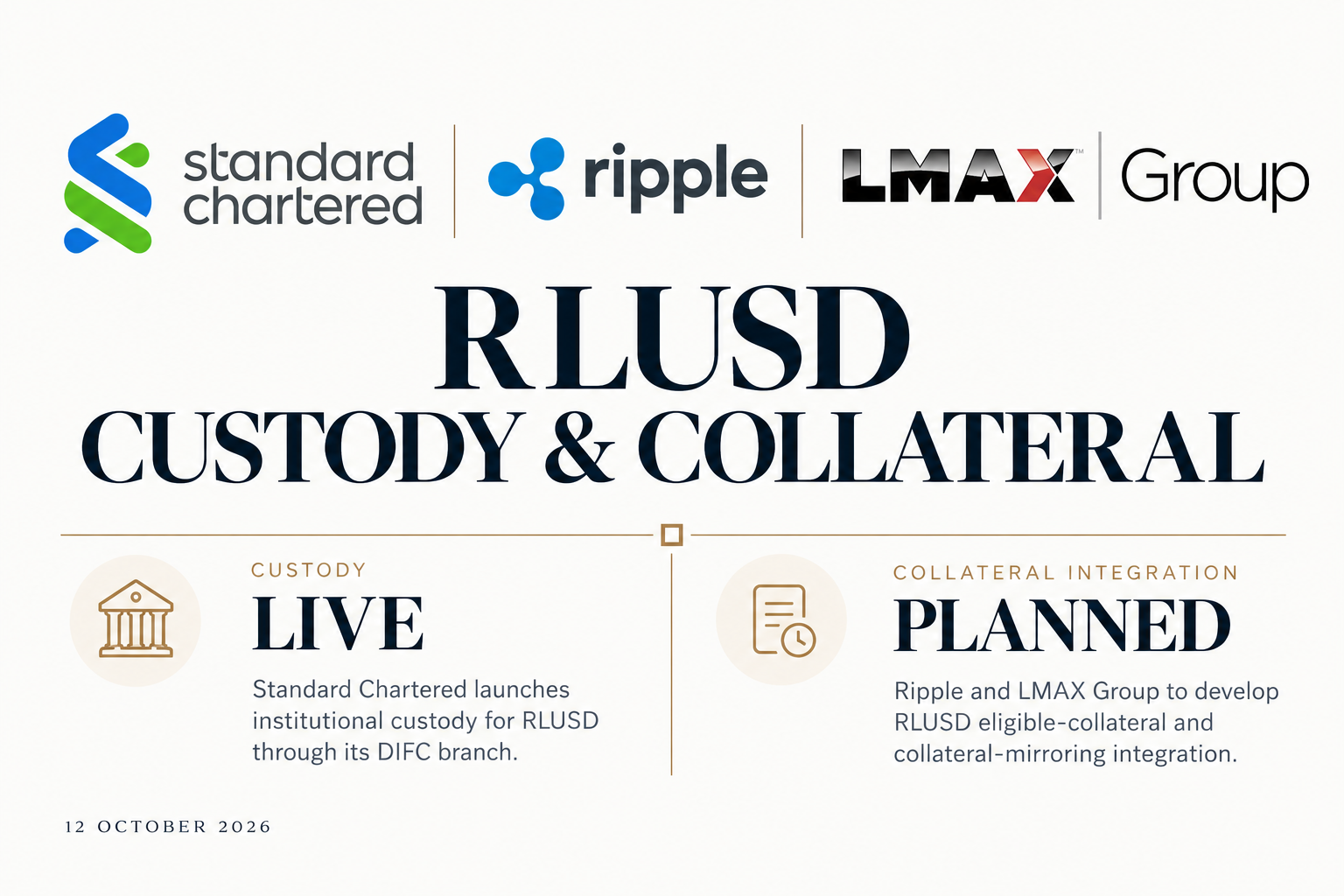
Standard Chartered has launched institutional custody for Ripple USD (RLUSD) on the XRP Ledger, adding the dollar stablecoin to its regulated digital asset custody offering.
The service is available to eligible institutional clients through Standard Chartered Bank's Dubai International Financial Centre (DIFC) branch, which is regulated by the Dubai Financial Services Authority.
The bank is also working with Ripple and LMAX Group on a separate arrangement intended to make RLUSD eligible collateral for selected LMAX trading and collateral management services.
The distinction between the two developments matters. Custody support is already operational. The proposed collateral integration remains subject to documentation, testing, regulatory requirements and internal approvals.
From custody to collateral management
The planned arrangement extends Standard Chartered's collateral mirroring model to RLUSD held for institutional clients.
Under the proposed structure, the value of eligible collateral would be reflected within LMAX Group's trading environment without requiring the underlying stablecoin to be transferred directly to the venue.
This separates two functions that are often combined in digital asset markets: holding an asset and making its value available to support trading activity.
For institutional participants, that separation can be important.
Moving assets to an execution venue may introduce additional counterparty exposure, operational dependencies and reconciliation requirements. A custody-based collateral structure could allow clients to maintain assets with a banking institution while making those positions available within an agreed trading framework.
The model does not remove collateral risk. It changes how that risk may be managed.
The precise legal arrangements, valuation procedures, collateral eligibility rules and enforcement mechanisms will determine how the proposed service operates in practice.
An existing institutional relationship
The announcement builds on Standard Chartered's broader custody relationship with LMAX Group.
In September 2026, the bank confirmed its appointment as LMAX Group's digital asset custodian through its DIFC branch and Luxembourg subsidiary.
That agreement expanded a relationship that already included live digital asset prime brokerage activity.
The new RLUSD announcement adds a potential stablecoin collateral function to this existing institutional infrastructure.
This sequence matters because the proposed service is not being introduced as an isolated blockchain application. It is being developed around established custody, trading and banking relationships.
The institutional issue is control over collateral
Collateral management requires more than the ability to transfer an asset.
A functioning institutional model must establish who holds the collateral, who can instruct its use, how its value is calculated and what happens when an obligation is not met.
These questions become particularly important when the asset is a stablecoin.
RLUSD represents a dollar-denominated instrument that operates on blockchain infrastructure. Its use as trading collateral would introduce additional requirements around eligible balances, valuation, redemption access and coordination between the custodian and execution venue.
The proposed mirroring structure could reduce the need for direct transfers into venue-controlled infrastructure.
However, it would also require clearly defined procedures for maintaining the relationship between the custodied position and the collateral value recognised by LMAX.
A successful implementation would therefore depend on operational controls and enforceable arrangements, not simply the technical availability of RLUSD.
Why it matters
The development illustrates a specific direction in institutional stablecoin infrastructure.
Stablecoins are increasingly being considered for functions beyond transferring value between blockchain addresses. Their potential use in trading collateral, treasury and settlement depends on connections to regulated financial services.
Standard Chartered's custody launch provides one of those connections.
The planned LMAX integration addresses another: allowing institutional participants to deploy stablecoin collateral within an existing trading relationship.
If implemented successfully, the structure could reduce certain operational risks associated with transferring collateral between custodians and execution venues.
The announcement does not establish that these benefits have already been achieved.
Its importance lies in the operating model being developed, with bank custody and institutional trading infrastructure performing distinct but coordinated functions.
What to watch next
The next evidence of progress will be the completion of the proposed RLUSD collateral integration.
Several details will determine its institutional significance.
First is the legal treatment of collateral held within Standard Chartered's custody infrastructure and reflected at LMAX.
Second is the operational process for valuation, margin requirements, collateral adjustments and default management.
Third is the scope of eligible clients, products and jurisdictions.
Finally, actual production use will provide stronger evidence than the agreement itself. Recurring collateral activity, functioning controls and reliable reconciliation would demonstrate whether the proposed model can operate beyond its initial implementation.
For now, Standard Chartered has delivered the custody component. The broader collateral model remains the next step.
Source: Standard Chartered (12 October 2026).